
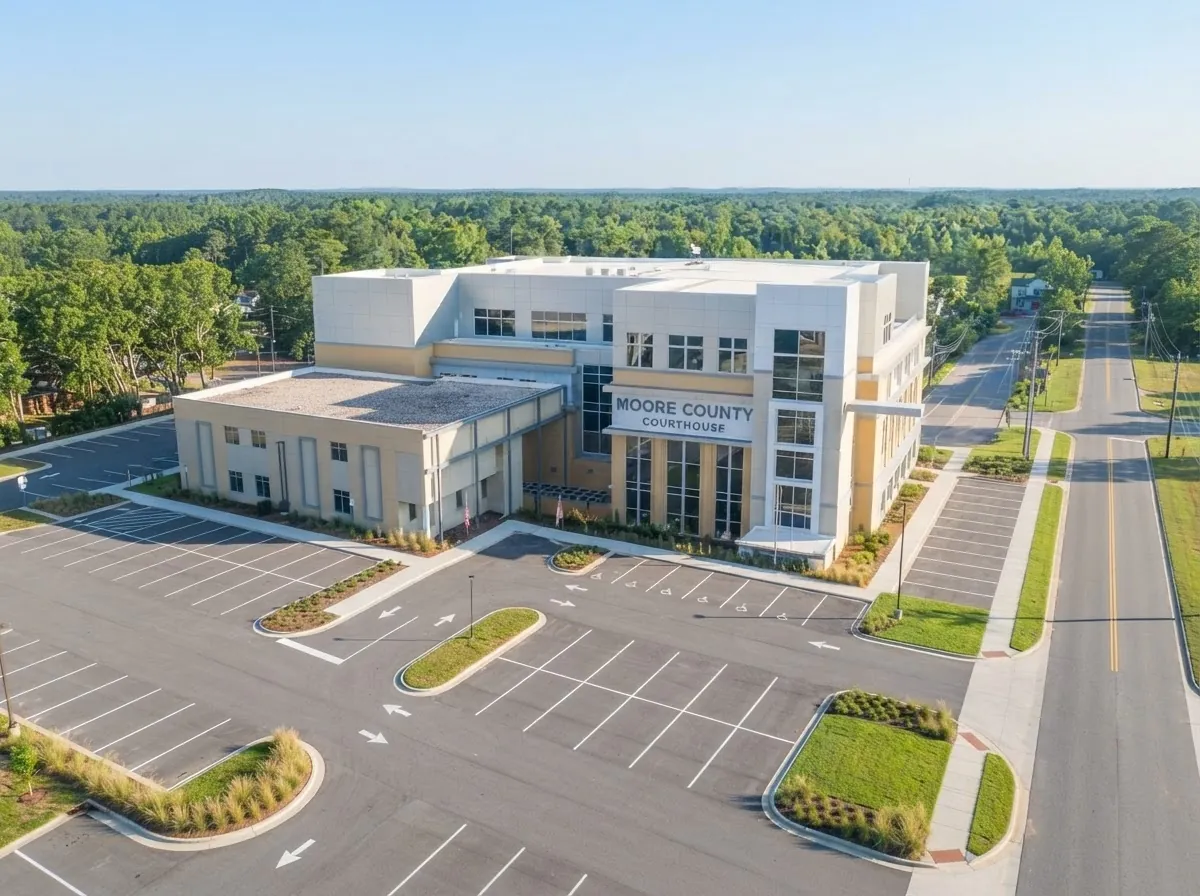
Moore County, North Carolina court records are maintained by the Clerk of the District Court and are accessible through official court portals, the clerk's office, and online tools. MooreCourt.us allows for quick access to public information about court records in this county. Additionally, you can use the North Carolina Judicial Branch portal for Moore County, visit the clerk's office in person, or consult other state government resources.
Moore Court System Overview
Moore County is part of Judicial District 19B in North Carolina. This district exclusively serves Moore County. The District Court and Superior Court operate in the courthouse in Carthage, the county seat. Magistrates act as a division of the District Court, handling minor cases, issuing warrants, and conducting initial hearings. The Superior Court handles serious criminal cases and civil claims involving substantial sums.
Clerk's office hours: typically Monday through Friday, 8:00 AM–5:00 PM. It's recommended to verify the current schedule on the Moore County page on the NC Courts website.
Courts Serving Moore
Residents of the county are served by several courts with different levels of jurisdiction:
| Court | Address / Contacts |
|---|---|
| Moore County District Court | 1 Courthouse Square, Carthage, NC 28327 |
| Moore County Superior Court | 1 Courthouse Square, Carthage, NC 28327 |
| Moore County Magistrate's Office | 1 Courthouse Square, Carthage, NC 28327 |
| U.S. Middle District of North Carolina (Federal) | 324 W. Market Street, Greensboro, NC 27401 |
| U.S. Bankruptcy Court, Middle District of NC | 101 S. Edgeworth Street, Greensboro, NC 27401 |
There are no municipal courts in North Carolina — all criminal and civil cases are handled at the state level through the District Court and Superior Court.
What Types of Cases Moore Courts Hear
Moore County courts hear a wide range of cases. Here are the main categories:
- Felonies and misdemeanors
- Traffic violations and infractions
- Civil claims and small claims
- Family law: divorce, custody, child support
- Probate, guardianship, conservatorship
- Juvenile cases, child protection, adoption
More details on each category can be found in the following sections.
District Court Cases in Moore
The District Court of Moore County handles misdemeanors, civil claims up to $25,000, and all family cases — from divorces to child custody. Additionally, this court hears appeals from magistrate decisions. Felony cases begin here with preliminary hearings before being transferred to the Superior Court. A district court judge presides, appointed according to the rules of Judicial District 19B. Case distribution among judges is managed administratively, considering the calendar and specialization.
Magistrate Court Cases in Moore
Magistrates in Moore County play a crucial role at the initial stage of the judicial process. They:
- Handle small claims up to $10,000
- Conduct preliminary hearings in felony cases
- Issue arrest and search warrants
- Set bail
- Administer oaths and certify documents
Magistrates also handle eviction cases and certain civil disputes within their jurisdiction. They operate 24/7, allowing for prompt processing of warrants and initial appearances of detainees. For traffic violations and DWI, the initial appearance usually takes place before a magistrate.
Family Law, Probate, and Juvenile Matters in Moore
Family Law. Divorce, custody, child support, paternity, and protective orders are handled by the District Court. Divorce certificates can also be obtained through NC Vital Records or from the clerk of the court where the case was filed.
Probate Matters. The clerk of the Superior Court acts as a judge in probate, guardianship, and conservatorship cases. The clerk's office is where you should go to open a probate case or appoint a guardian.
Juvenile Matters. The Juvenile Court operates as a division of the District Court. Juvenile delinquency and child protection cases are confidential — access to them is strictly limited. The Guardian ad Litem (GAL) program represents children's interests in such cases; information about the local GAL program can be found on the Moore County page.
How Cases Move Through the Moore Court System
- Case Initiation. A criminal case begins with a complaint or arrest warrant; a civil case starts with the filing of a complaint with the clerk's office.
- Judge Assignment. The case is assigned to judges according to the internal calendar of the judicial district.
- Initial Hearings. In criminal cases — arraignment and bail setting. In civil cases — an organizational conference.
- Pre-trial Phase. Parties file motions and exchange evidence (discovery). In criminal cases, plea bargaining may occur.
- Trial. The case concludes with a verdict, settlement, default judgment, or jury verdict (in Superior Court).
- Post-judgment. Sentencing, filing an appeal, or enforcing the court's decision.
Appeals from the District Court are filed with the Superior Court for a new trial (trial de novo), and from the Superior Court to the North Carolina Court of Appeals.
Court Administration, Local Rules, and Public Access in Moore
The administrative judge of District 19B coordinates the work of the Moore County courts. The Trial Court Administrator is responsible for day-to-day management, including scheduling and staffing issues.
Local rules of the judicial district are published on the NC Judicial Branch for Moore County website. Before filing documents, it is advisable to familiarize yourself with them — format and timing requirements may differ from state-wide rules.
Public Access to Records. According to North Carolina law, most court records are public. The NC Open Government Guide explains which documents can be accessed and which have restrictions — including juvenile records, sealed cases, and grand jury materials. Paper copies of cases can be viewed by visiting the clerk's office in the Carthage courthouse.
Court sessions are generally open to the public. To confirm the possibility of remote participation, contact the clerk's office at (910) 947-6370.
Court Records and Related Court Resources in Moore
- Online Case Search. The Court Records portal on the NC Judicial Branch website allows you to search for information on criminal and civil cases statewide.
- Court Calendar. The current hearing schedule is available on the Moore County page — look for the Court Dates section.
- Forms and Self-Help Resources. The NC Courts website has a library of forms for self-filing claims, motions, and petitions.
- Clerk of Court's Office. To obtain copies of court records, contact the clerk's office. The procedure for obtaining copies requires an in-person visit or a written request; there is a fee for copies.
- Register of Deeds. The Office of the Register of Deeds Moore County maintains records of real estate, marriages, and other public documents.
- Inmate and Offender Search. The NC Department of Adult Correction provides a database of convicted, paroled, and registered sex offenders with records dating back to 1972.
- State Public Records. The NC DAC Public Records page contains links to criminal case and correctional facility databases.
- Moore County Sheriff's Office. The Sheriff's Office provides copies of incident reports and other law enforcement documentation.
- Detention Center. Information on visitation and services for inmates can be found on the Detention Center page.
- Property and Tax Records. The Look Up portal provides access to property appraisal and county tax records.
- NC Vital Records. Birth, death, and marriage certificates are ordered through NC Vital Records — these documents are not free.